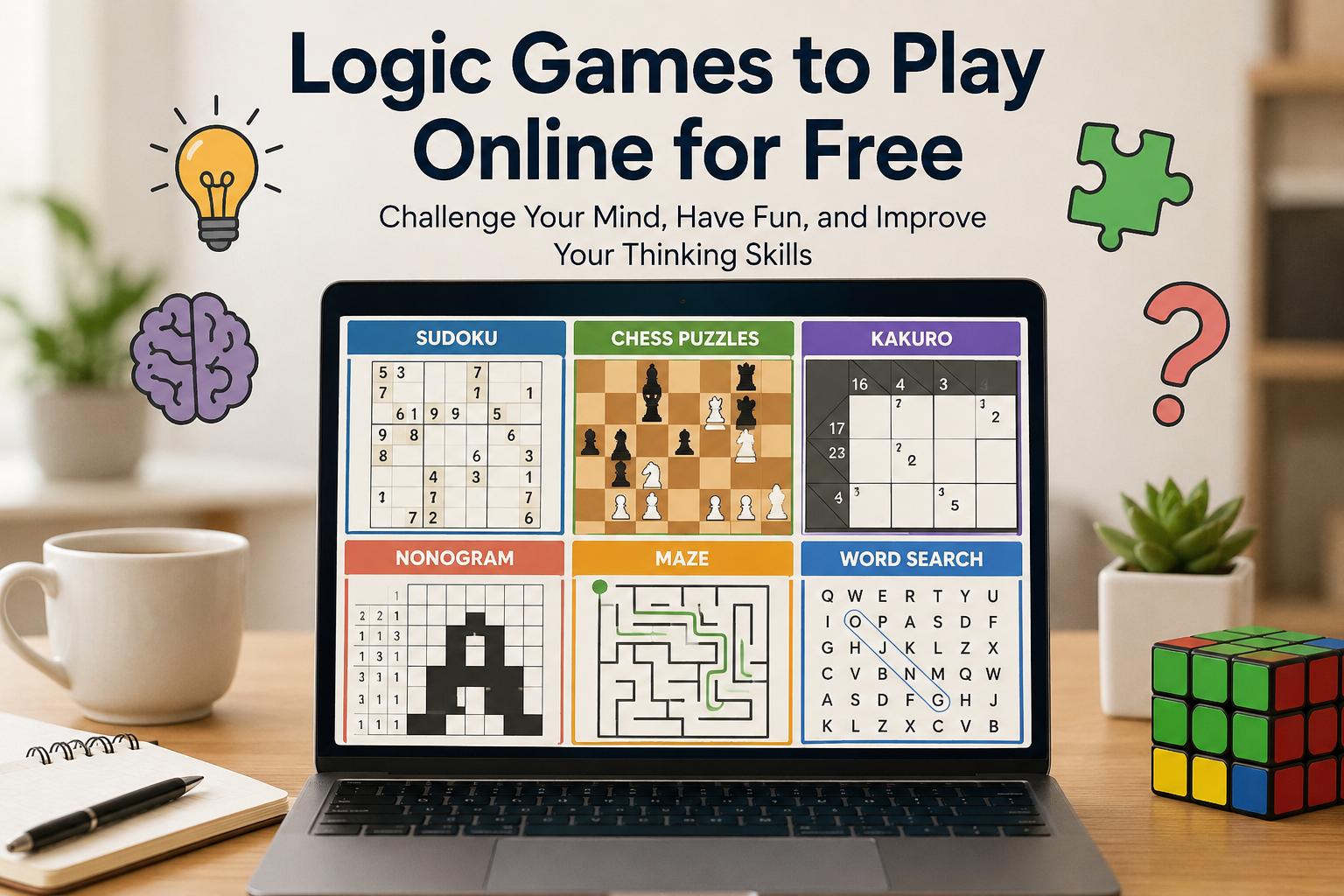
I have always liked games that make me think instead of simply asking me to react quickly. There is something satisfying about looking at a problem, trying different ideas, making a mistake, and finally finding the right answer. That is why logic games have become one of my favorite types of online games.
The good thing is that you do not need an expensive computer or a gaming console to enjoy them. Many logic games can be played directly in a browser for free. You can play them during a short break, while relaxing at home, or whenever you want to give your brain something interesting to work on.
In this article, I want to share some of the best types of logic games that I enjoy playing online. These games are simple to start, but many of them can become surprisingly challenging once you move to harder levels.
What Are Logic Games?
Logic games are games that require you to use reasoning, observation, memory, planning, or problem solving to reach a goal. Unlike games that depend mostly on fast reflexes, logic games usually give you time to think about your next move.
Some games ask you to complete a number puzzle. Others may require you to find a hidden path, arrange objects correctly, recognize a pattern, or solve a difficult problem.
What I personally enjoy most about logic games is that every puzzle feels like a small challenge. Even when the game looks simple at first, the solution can require much more thought than expected.
Sudoku
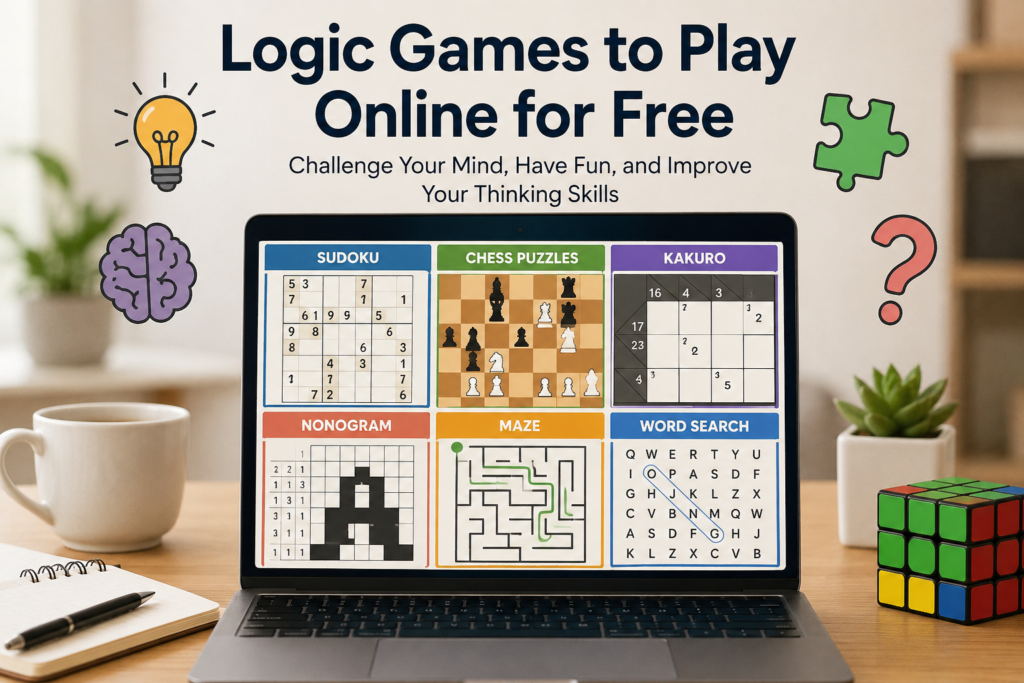
Sudoku is probably one of the first games that comes to my mind when I think about online logic games. The basic idea is simple. You have a grid and need to place numbers in the correct positions without repeating them in the same row, column, or section.
I like Sudoku because I can choose a difficulty level depending on how much time and patience I have. An easy puzzle can be completed during a short break, while a difficult puzzle can keep me busy for much longer.
Playing Sudoku also encourages careful thinking. Instead of guessing randomly, I usually look for numbers that have limited possible positions. Once I find one useful clue, it can help me solve several other parts of the puzzle.
Online Chess Puzzles
Chess is already a game based heavily on logic, but chess puzzles make the experience even more focused. Instead of playing an entire match, you are usually given a particular position and asked to find the strongest move.
I enjoy these puzzles because they make me look at the board differently. I have to consider what the opponent might do next instead of thinking only about my own move.
Chess puzzles can also be very quick. Sometimes the solution is obvious after a few seconds, while other positions require several minutes of careful calculation.
For beginners, simple chess puzzles can be a fun introduction to strategic thinking without the pressure of playing a complete game.
Nonogram Puzzles
Nonograms are another type of logic puzzle that I find surprisingly enjoyable. They use numbers around a grid to give clues about which squares should be filled.
At first, a large nonogram can look confusing. However, once you understand how the clues work, the puzzle starts becoming more manageable.
The interesting part is that completing the correct squares gradually creates a picture. So you are not only solving a logic problem but also discovering an image as you progress.
I think nonograms are a good choice for people who enjoy visual puzzles and want something different from traditional number games.
Maze Games
Maze games are simple to understand, but they can still require plenty of concentration. The objective is normally to find a path from one point to another without getting trapped.
Some online maze games are very easy, while others include complicated paths with dead ends and multiple possible routes.
When I play a maze, I try not to rush. I usually look at the available paths and decide which direction makes the most sense. This makes the game feel more like a small planning exercise than a race.
Maze games are also useful when you want something relaxing. You can enjoy a simple maze without needing to learn complicated rules.
Pattern Recognition Games
Pattern recognition games are based on finding relationships between shapes, numbers, symbols, or objects.
For example, a game might show you a sequence of shapes and ask which shape should come next. Another game may show several objects and ask you to identify the one that does not belong.
I like these games because they encourage me to look for details that I might normally ignore. Sometimes the pattern is based on size or position. Other times it may involve color, numbers, rotation, or repetition.
These games can be especially entertaining because the solution often feels obvious once you finally notice the pattern.
Memory Logic Games
Memory games may seem different from traditional logic puzzles, but they can still require plenty of concentration. You might need to remember where certain symbols appeared or match identical objects after they have been turned over.
I enjoy these games when I want a quick mental challenge. They do not always require a long session, and you can often complete a round within a few minutes.
The difficulty can increase quickly when more cards or symbols are introduced. That makes the game interesting because you have to pay attention from the beginning.
Word Logic Games
Word games are another great category for people who enjoy thinking. Some require you to rearrange letters, discover hidden words, complete patterns, or solve clues.
What I like about word logic games is that they combine language skills with problem solving. Sometimes I know the answer but cannot immediately find the correct letters. Other times, discovering one word gives me a clue for another.
These games can also be a nice way to spend a few quiet minutes without feeling like you are doing something too serious.
Number Logic Games
If you enjoy mathematics, number logic games can be a great choice. They can include number sequences, mathematical patterns, calculation puzzles, and challenges where you need to reach a specific result.
I prefer games that make me think about numbers without feeling like a traditional math exercise. The best ones turn the problem into a game where finding the answer feels rewarding.
Number puzzles can also have different difficulty levels, so beginners and experienced players can usually find something suitable.
Why I Enjoy Free Logic Games
The biggest reason I like free logic games is convenience. I do not have to download a large application or spend money before trying a new game. I can simply open a browser and start playing.
Another advantage is variety. If I get bored with Sudoku, I can move to a maze. If I want something more strategic, I can try chess puzzles. If I want a visual challenge, I can choose a nonogram.
This variety keeps online puzzle gaming interesting.
I also like the fact that many games can be played in short sessions. Not every gaming session needs to last an hour. Sometimes I only have ten minutes, and a quick logic puzzle is perfect for that amount of time.
How to Choose the Right Logic Game
I think the best way to choose a logic game is to consider what type of thinking you enjoy.
If you like numbers, Sudoku and number puzzles are good places to start. If you enjoy strategy, chess puzzles may be more interesting. If you like visual challenges, nonograms and pattern games are worth trying.
For something simple and relaxing, I would choose a maze or an easy word puzzle.
Difficulty is also important. I recommend starting with an easy level if you are new to a particular type of game. Once you understand the rules, you can gradually increase the difficulty.
There is no need to choose the hardest puzzle immediately. For me, the most enjoyable experience comes from finding a challenge that makes me think without becoming frustrating.
Tips for Solving Logic Games
One of my biggest tips is to avoid guessing too quickly. When a puzzle becomes difficult, it can be tempting to click randomly or choose an answer simply because it looks right.
Instead, I try to collect information first. I look for obvious clues and use those clues to eliminate incorrect possibilities.
Another useful habit is taking a short break when you feel stuck. Sometimes staring at the same puzzle for too long makes it harder to see the solution. After a few minutes away from the screen, the answer can suddenly become much easier to notice.
I also recommend trying different types of puzzles. Solving the same type of puzzle repeatedly can become predictable, while switching between different games keeps your thinking fresh.
Final Thoughts
For me, free online logic games are a great combination of entertainment and mental challenge. They are easy to access, available in many different styles, and suitable for both short breaks and longer gaming sessions.
Whether you enjoy Sudoku, chess puzzles, mazes, nonograms, word games, memory challenges, or number puzzles, there is probably a logic game that matches your interests.
The best part is that you do not need to be an expert. You can start with simple puzzles and improve naturally as you play more.
If you are looking for something different from action games or endless scrolling, I think free online logic games are definitely worth trying. Pick a puzzle that looks interesting, take your time, and enjoy the process of figuring things out. For me, that moment when a difficult puzzle finally makes sense is what makes these games so enjoyable.